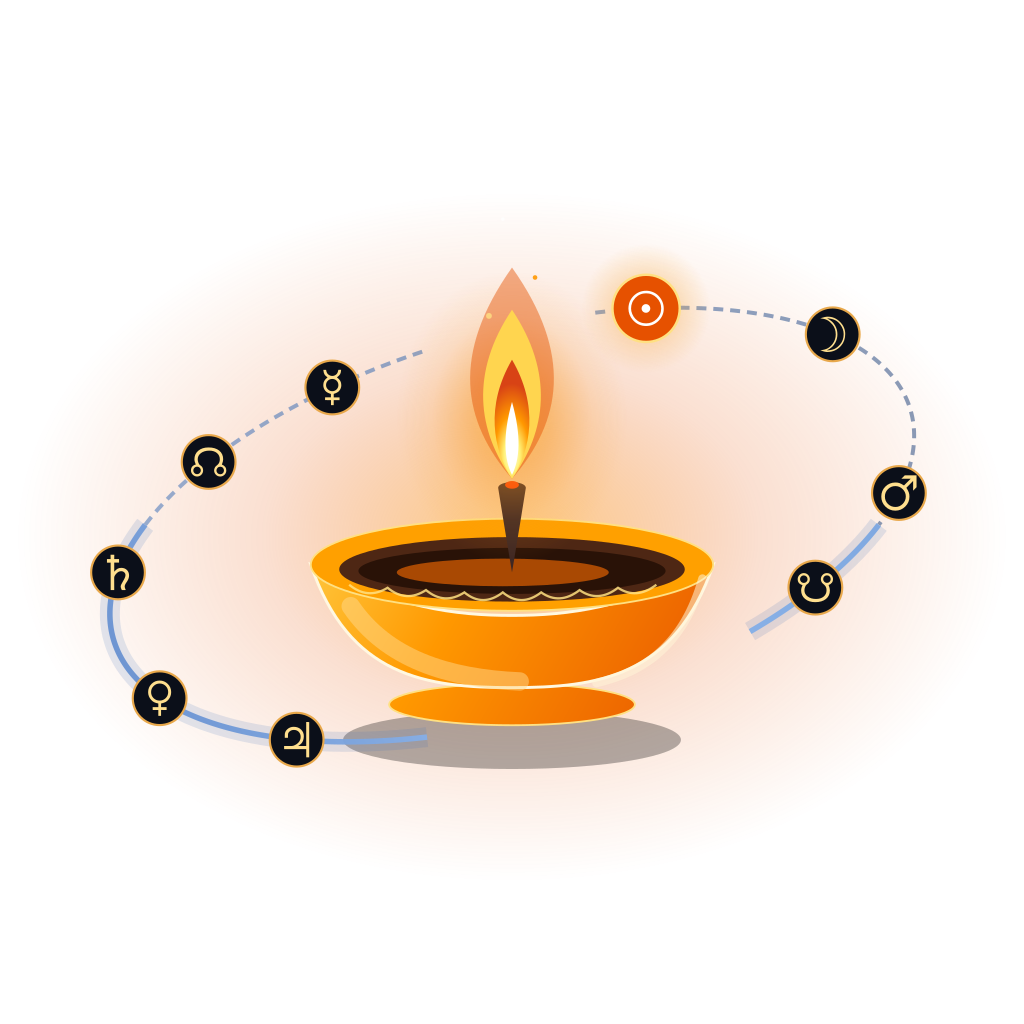
Navagraha: the nine planets of Vedic astrology
Sun, Moon, Mars, Mercury, Jupiter, Venus, Saturn — plus Rahu and Ketu, the shadow planets. What each graha signifies, and why Jyotish counts nine instead of ten.
Jyotish works with nine grahas (ग्रह — literally “graspers,” things that seize hold of your life). Seven are physical bodies you’d recognize; two are mathematical points. Here’s each one’s core meaning.
The luminaries
- Sun (Surya) — self, vitality, father, authority, soul purpose. Your public engine.
- Moon (Chandra) — mind, emotions, mother, memory, public response. In Jyotish the Moon matters more than the Sun — it sets your dasha clock.
The inner planets
- Mars (Mangal) — energy, courage, aggression, siblings, property, surgery. Drive, for better and worse.
- Mercury (Budha) — intellect, speech, trade, analysis, wit. How you think and explain.
- Jupiter (Guru) — wisdom, expansion, children, teachers, fortune. The great benefic; growth and meaning.
- Venus (Shukra) — love, beauty, art, comfort, vehicles, relationships. Pleasure and partnership.
The heavyweight
- Saturn (Shani) — discipline, delay, labor, longevity, consequences. The most feared graha and the most misunderstood: Saturn doesn’t punish, it matures. Sade Sati — its 7.5-year transit over your Moon — is its famous transit.
The shadow planets — Rahu and Ketu
Rahu and Ketu are the lunar nodes — the two points where the Moon’s orbit crosses the ecliptic. No physical body, but eclipses happen there, so the tradition treats them as powerful:
- Rahu — obsession, ambition, foreign things, illusion, sudden rise. Amplifies whatever it touches.
- Ketu — detachment, spirituality, past-life residue, sudden loss. Dissolves whatever it touches.
They’re always opposite each other in the chart — one axis of compulsion and release.
What about Uranus, Neptune, and Pluto?
Not cast — the dashas, yogas, and vargas are all built on nine, and the system is complete with nine actors.
The practical takeaway
In a reading, every claim traces back to a graha’s nature + its placement + whose period is running. “Mercury dasha in a strong 10th house” is a sentence built from this table. TevaPatra shows you each planet’s full state — sign, house, dignity, nakshatra — because the generic keyword (“Mercury = communication”) is only ever half the answer.
The light on your karma
Your AI Vedic astrologer for birth charts, dasha timelines, and answers in your own language.
Get new posts by email:
New posts only — no spam, ever.
Or follow along: